
618 Leads.
Three No. 1 Rankings. One Firm at the Top of the Page.
How a coordinated paid and organic program put a Houston business law firm in front of the people already looking for counsel.
BoyarMiller, a Houston business law firm, set out in 2022 to raise awareness in specific industry verticals and capture prospective clients who were actively searching for legal counsel. Savage built an integrated program combining Google Ads, display advertising, retargeting, content marketing and search engine optimization, with geo-targeted paid campaigns split between general business law and litigation on one track and insurance agency owners navigating mergers and acquisitions on another. Organic work began with a baseline keyword report, then produced new content optimized for the terms that mattered most to the firm’s practice areas. Display and retargeting borrowed a method more common in e-commerce, re-engaging visitors who had already shown interest through paid or organic channels.
generated through the Google Ads campaigns
from display advertising and retargeting
for priority search terms
plus one listing in Google’s People Also Ask results
across tracked keywords in Google Search
average session duration on the website
Reputation Opens Doors.
It Does Not Open a Browser.
BoyarMiller has a long-standing reputation among Houston business owners and entrepreneurs. Reputation travels through relationships, and relationships take time. The firm wanted a second path, one that reached prospects at the moment they decided they needed counsel rather than months earlier at an industry function.
That moment almost always begins with a search. A business owner facing a contract dispute, an acquisition or a real estate matter opens Google before calling anyone. Whoever occupies that results page shapes the shortlist, the goal for this campaign.
Without clear attribution, the firm could not distinguish between advertising that generated inquiries and advertising that generated activity. Before spending could be optimized, the tracking had to be trustworthy.
Savage Built Two Paid Campaigns for Two Different Buyers
Google Ads strategy started with geo-targeting business owners and entrepreneurs across greater Houston, using a keyword approach selected on volume, location, relevance and cost. Rather than running a single campaign across the firm’s full practice range, the team split it in two.
The first campaign targeted general business law and litigation, reaching prospects with immediate legal need across a broad set of circumstances. The second campaign spoke to a narrower audience: insurance agency owners seeking legal support during mergers and acquisitions. That audience searches differently, uses different vocabulary and responds to different messaging, and separating it allowed both budget and copy to be tuned for a specific transaction type rather than averaged across everything.
Organic Work Built the Positions That Paid Media Cannot Buy
Search engine optimization began with a baseline report of currently ranked keywords and identification of the terms that would matter most to the firm’s growth. Relevant keywords then informed new content development, with on-page and backend optimization applied to support ranking improvement.
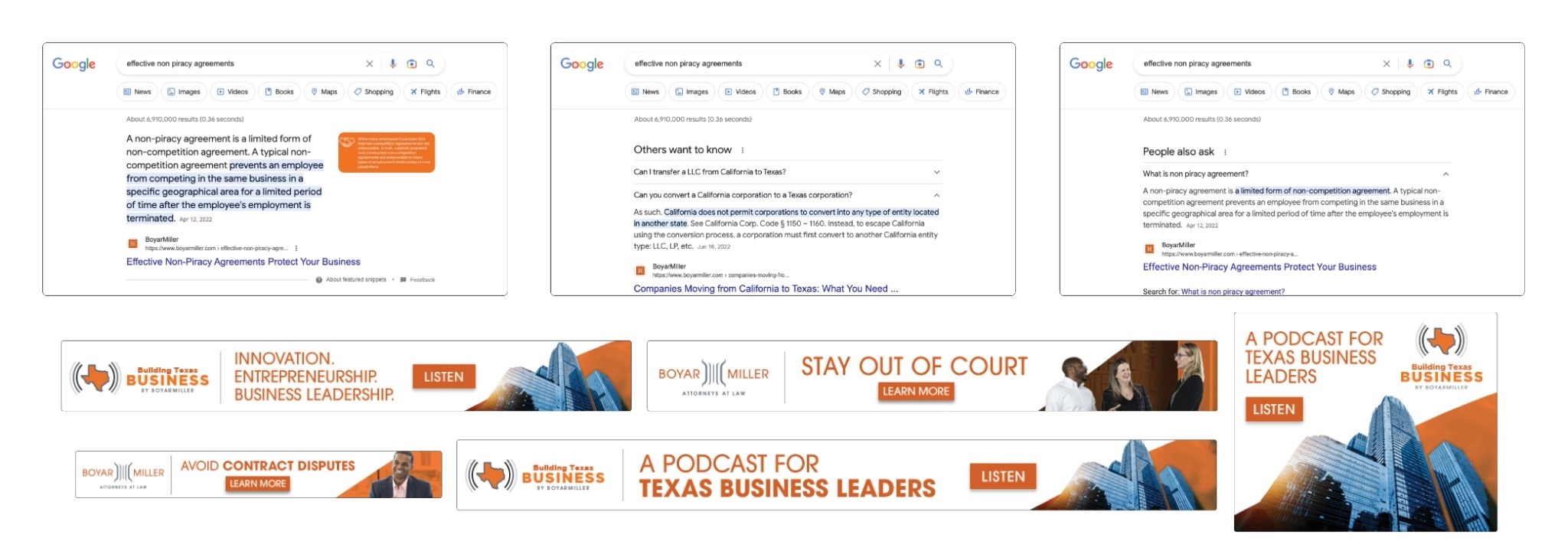
The results reflect the difference between renting attention and earning it. The firm secured three No. 1 rankings, two featured snippets and a listing in Google’s People Also Ask section, with average position across tracked keywords improving 22%. Snippet and People Also Ask placements carry particular value because they answer the question directly on the results page, which positions the firm as the authority before the click and, as it turned out later, feeds the same content to AI platforms that draw on structured answers.
Retargeting Borrowed From Retail and Applied It to Legal Services
Display and retargeting followed a method more familiar to e-commerce brands, where a shopper who views a product is followed with relevant messaging until they return. The logic transfers to professional services with one adjustment. A prospect researching legal counsel needs reassurance and information rather than a discount.
The campaign captured highly engaged users who had already visited the BoyarMiller site through paid or organic channels, then re-engaged them with relevant, helpful content. Display and retargeting produced 2.9 million impressions, and average session duration rose 8.68%, an indication that returning visitors were reading rather than bouncing.
Better Tracking Made the Numbers Usable
BoyarMiller installed CallRail, a third-party application that tracks phone calls and form field submissions against their originating source. In legal services, where a significant share of inquiries arrive by phone, call tracking closes a gap that web analytics alone cannot. The firm could finally see which campaigns produced conversations, which made the 618 leads a figure the team could act on rather than simply report.
How many leads can a law firm expect from Google Ads?
Volume depends on market size, practice area competition and budget. BoyarMiller’s 2022 campaigns produced 618 leads across two geo-targeted campaigns in greater Houston. The more useful benchmark for any firm is cost per qualified consultation rather than raw lead count, since legal keywords carry some of the highest click costs in paid search.
Why split a law firm’s paid search into multiple campaigns?
Different clients search with different language and different urgency. BoyarMiller ran one campaign for general business law and litigation and a second for insurance agency owners pursuing mergers and acquisitions. Separating them allowed budget, keywords and messaging to be matched to each audience rather than diluted across both.
Does retargeting work for professional services?
It does, with a change in approach. E-commerce retargeting pushes toward an immediate purchase. Professional services retargeting keeps a firm present during a longer consideration period with content that helps the prospect think through the decision. BoyarMiller’s display and retargeting program generated 2.9 million impressions and coincided with an 8.68% increase in average session duration.
What is a featured snippet, and why does it matter for a law firm?
A featured snippet is the answer Google displays above the standard results, pulled from a page it considers authoritative. Holding one positions the firm as the source of record for that question. The value has grown since these placements were earned, because structured answer content also improves how AI platforms represent a firm.
Why do law firms need call tracking?
Because most legal inquiries still arrive by phone, and web analytics cannot see them. BoyarMiller implemented CallRail to attribute calls and form submissions to their source, which made it possible to judge campaign performance on conversations rather than on clicks.
How do paid and organic search work together?
Paid search delivers immediate visibility for high-intent terms while organic positions build. Organic rankings then reduce dependence on ad spend for the same traffic. Running both let BoyarMiller capture leads during the period when its organic positions were still improving.
Be There When They Start Looking.
Your next client is searching right now, and they will call whoever appears first with a credible answer. Savage builds the paid and organic programs that make sure the name they find is yours.